
Allen County Address History Sources
Choose a source by period before searching for past residents. Current parcel tools are strong entry points, but the older trail shifts to deed indexes, printed directories, maps, newspapers, probate, and the first federal land records. Coverage overlaps unevenly, which is useful: one source can test another.
| Source | Years it covers | Where held | What it shows |
|---|---|---|---|
| Recorder online index | Generally 1970-present, some earlier | Allen County Recorder | Recorded parties, date, instrument reference |
| Tapestry name search | Back to 1950 | Recorder service | Name-index leads and document access |
| ACGSI deed index | Most deeds 1824-1903 and 1913-1999 | ACGSI online | Grantor, grantee, deed reference |
| Fort Wayne directories | Runs including 1858-1910 | ACPL Genealogy Center | Name, address, work, spouse or boarding clues |
| Sanborn maps | 1890, 1902, 1918-1951 | Library of Congress and local repositories | Building footprint, use, material, height, number |
| Federal land records | Fort Wayne land office from 1823 | Indiana Archives | Purchaser, legal description, acres, receipt, residence |
For a recent address, begin with the assessor and Recorder. For the mid-twentieth century, pair directories with Recorder name coverage. Before 1900, expect repository indexes and deed books, then use early land records only for the first federal transfer rather than later private sales.
Trace Allen County Past Owners
A deed chain follows legal ownership, not every person who occupied the building. Start with today's owner and legal description in the county property record. Then work backward through transfers, using the seller on one deed as the buyer on an earlier deed. Preserve document numbers, dates, book and page references, and the exact legal description.
- Find the parcel in the Assessor card search or COMPS and record its PIN, owner label, situs address, and legal description.
- Search the current owner's purchase in the Recorder's Free Data Search. Move to an image service or office copy when the actual terms matter.
- Read the seller, or grantor, on that deed. Search that person as the earlier buyer, or grantee, for the same legal description.
- Repeat the transfer link. Do not join two deeds on name alone when the parcel, spouse, middle initial, or dates do not agree.
- At the online cutoff, use ACGSI, ACPL, the Recorder office, deed books, or microfilm rather than declaring the chain finished.
- Grantor
- The person or entity transferring an interest in the recorded document.
- Grantee
- The person or entity receiving the interest.
- Chain of title
- The linked sequence of recorded transfers for the same land.
- Legal description
- The lot, tract, section, or metes-and-bounds wording that identifies land more reliably than a changing street number.
The ACGSI historical deed index is a key bridge for Allen County past-resident research.
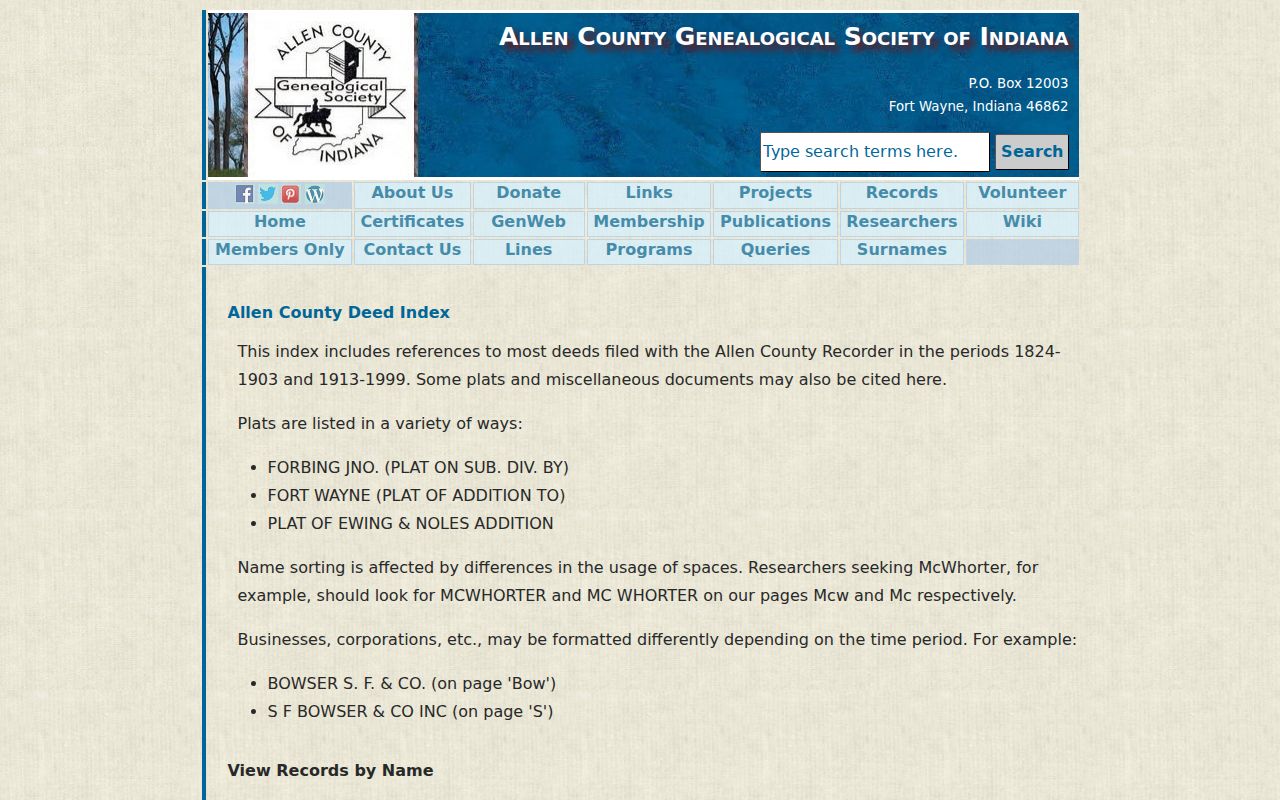
The captured index illustrates why a deed reference should lead to the instrument or deed book, not stand as the final proof by itself.
Allen County's Deed Index Seams
The Recorder reports more than 3.1 million documents online, generally from 1970. That large number still does not mean every earlier transaction is available through one search. Tapestry reaches name searches back to 1950, but address and PIN searching can be unreliable before 1995. The free route returns index data without images.
ACGSI says its index covers most deeds from 1824 through 1903 and from 1913 through 1999. The status of 1904 through 1912 is not clarified. Names with spaces and business formatting may sort in unexpected ways. Search variants, then verify the deed reference with the Recorder, library, or image collection.
The Recorder search page explains the current online and office choices.
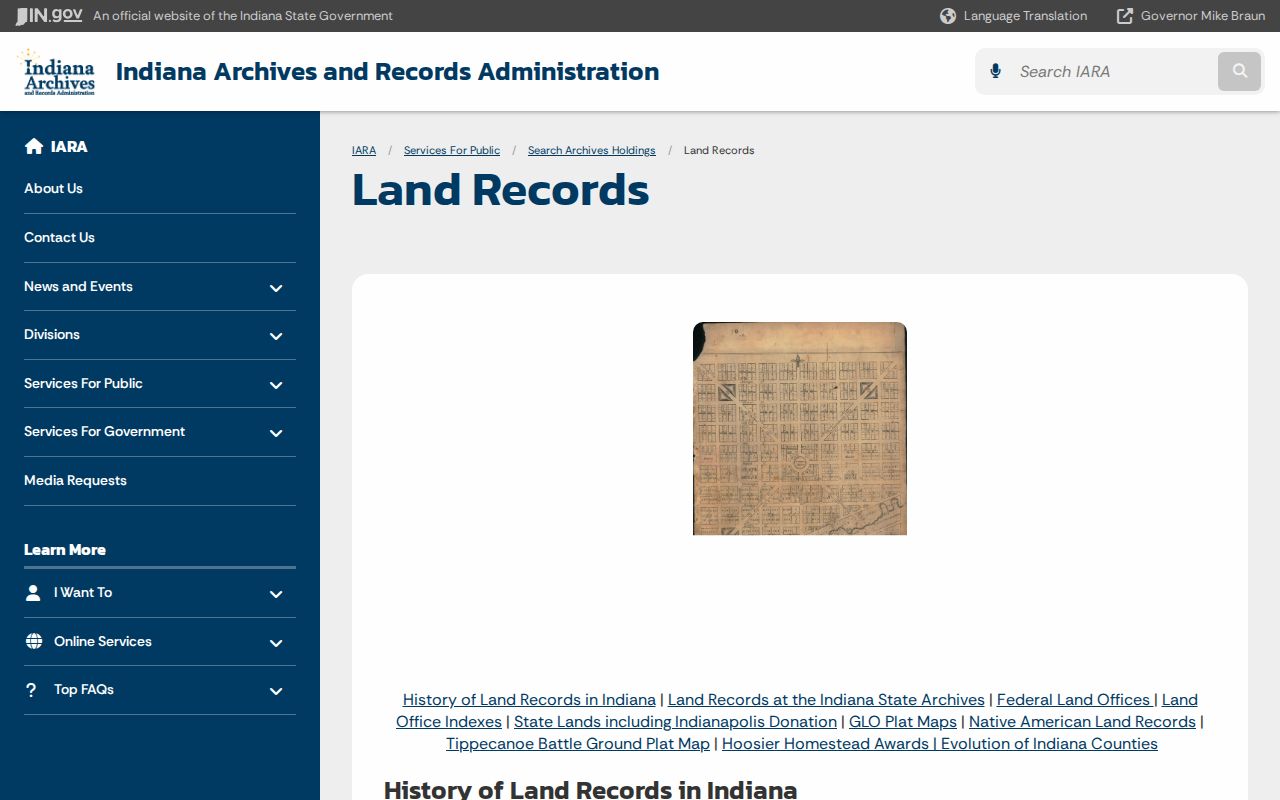
This captured Indiana land-record route is the fallback for the first federal tract, while later private transfers remain an Allen County Recorder question.
Note: Treat 1904-1912 as an unresolved index seam and ask the repository, rather than assuming that no deed exists.
Allen County Before County Deeds
The Fort Wayne federal land office opened in 1823, one year before Allen County was organized. Indiana Archives tract books can identify a purchaser, legal description, acreage, receipt, residence, and notes for first federal land sales. That is the starting line for a parcel's land story, not a substitute for later county deeds.
Search the Indiana Archives land holdings by purchaser or legal description, then carry the tract forward to county sources. Modern street addresses usually did not exist at the first sale, so township, range, section, tract, and later plat references are the bridge.
Recording the original wording matters. A place can be well documented even when a current search box cannot recognize the description.
Previous Residents Across 1902
Fort Wayne's 1902 street-number change can split one home's record trail into two apparent addresses. A previous resident may appear to vanish from the directory when only the number changed. Compare a directory before the shift with one after it, then place both forms on a Sanborn sheet or street guide.
City code and the 1913-14 handbook explain the river-and-Calhoun origin and the one-hundred-numbers-per-block pattern. Older records may describe squares east or south. Preserve those words first. Normalize them only after a dated map and directory support the conversion.
The Allen County street history search is therefore a map problem as much as a name problem. A modern parcel result alone cannot settle an old address.
Find Allen County Past Households
Ownership is only half the answer to who lived here before. A printed directory may name a householder, spouse, boarder, occupation, or business tie. A census page may show the whole household, its relationships, ages, and neighbors as of the enumeration date. An obituary can provide a later life-event citation. None should be read as a timeless residence statement.
- Choose a target year and locate the address in the nearest directory edition, checking old and new number forms when needed.
- Find the nearest public federal census year. Use street, enumeration district, neighbors, and household names to test the match.
- Compare the next directory edition. A change between annual volumes narrows the likely move period.
- Search newspaper, obituary, cemetery, probate, or deed indexes for the named household, using the address and year as independent anchors.
The collections themselves are described on the Allen County city directory page. Here they serve one address and one timeline.
The Fort Wayne and Allen County database index gathers useful local entry points.
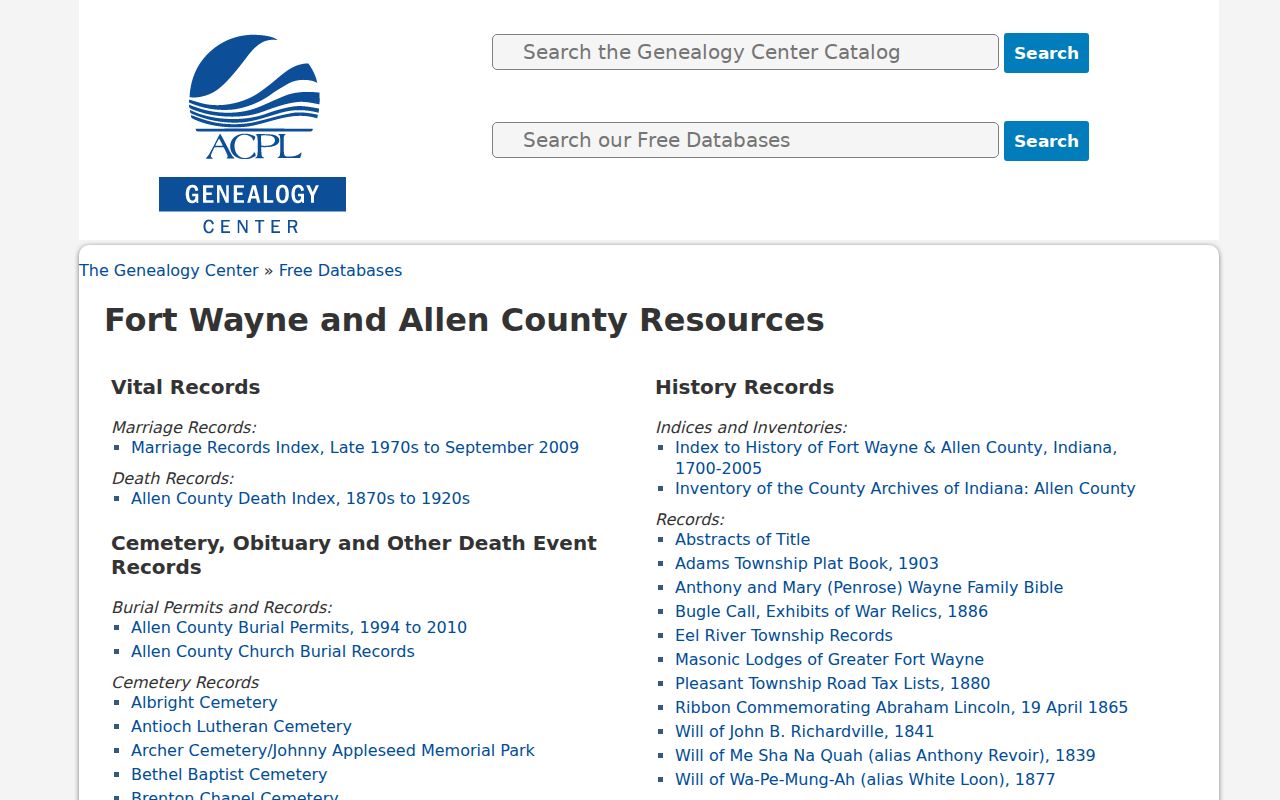
The image shows how local indexes can supply a citation or name variant that sends the search back to the original directory, newspaper, or record.
Allen County Previous Residents Indexes
The Allen County Public Library Genealogy Center holds directories, microtext, newspaper film, obituary and cemetery indexes, courthouse material, family files, and maps. Staff can help locate a source that is not exposed in a public portal. The center is at 900 Library Plaza and can be reached at 260-421-1225 or genealogy@acpl.info.
The ACPL city-directory history explains how these volumes preserve dated household evidence.
The captured library feature helps connect a historical address to the correct volume before a census or obituary is consulted.
ACGSI adds deed, probate, cemetery, voter, school, map, directory, and other local indexes. Its records page is especially valuable when a name search needs a source citation instead of a broad web result.
The ACGSI local records index shows the breadth of those Allen County finding aids.
This image anchors the genealogy fallback chain when a deed, directory, or person index is not available through a county portal.
Map Allen County Previous Residents
Sanborn fire-insurance maps can date the building rather than the household. Their details include footprint, material, height, use, and nearby features. Compare those facts with directories and deeds. If a structure changes shape or disappears between sheets, that may explain a gap without proving why the change occurred.
The History Center keeps photographs, maps, manuscripts, artifacts, and other Fort Wayne and Allen County collections. Its holdings can add street scenes, institutional records, or neighborhood context when a portal has only names and dates.
The History Center collections provide the archival route.
The captured collection page points beyond property indexes to the visual and manuscript evidence that can distinguish one address from another.
Allen County Household Endpoints
Obituaries, cemetery records, and probate can explain where a household trail goes next. ACPL's Fort Wayne obituary index covers newspapers from 1837 through March 25, 2026 and searches surname, first name, match method, and obituary date. A result is a citation to retrieve, not a certified life record.
Allen County Health genealogy records begin earlier for some local events than the statewide system: Fort Wayne births from 1882 and deaths from 1871, compared with outside-city county starts of 1887 for births and 1907 for deaths. Eligibility, identity, fees, and certified-copy rules apply. Marriage, divorce, and probate belong with the Clerk, whose historical holdings reach back to 1824 but are not all online.
A date, address, spouse, or probate case can test whether an obituary belongs to the same previous resident. Keep uncertain links labeled as leads.
Limits on Allen Previous Residents
A full backward address trail may still have gaps. Owners and occupants differ. Directories omit some people, census releases stop under the federal waiting rule, map dates are snapshots, and online Recorder coverage does not equal all retained records. Spelling, remarriage, business ownership, annexation, and address changes can also break a name-only search.
State what was not found and name the next custodian. The Recorder office, Clerk Rooms 201 and 202, ACPL Genealogy Center, ACGSI, History Center, Indiana Archives, and a focused APRA request each close different gaps. Requests should identify the existing record, address or legal description, person, and date span with reasonable particularity.
Lawful use. Research Allen County past residents for house history, family history, heirs, or personal curiosity, never to track, threaten, or harass a living person.